
Massage Therapy for Headaches Gets to the Root of Chronic Tension
Have you ever waited out a headache?
You dim your screen, reach for something in the medicine cabinet, and power through the rest of the day. It works, sort of, until it stops working.
If your headaches keep coming back, that cycle is worth paying attention to. Your body is repeating itself for a reason, and that reason is usually sitting somewhere in your neck, your jaw, or the muscles quietly bracing across your upper back.
Massage therapy for headaches addresses what's actually driving the pain. Not just the ache you feel in the moment, but the tension patterns that have been building up for weeks, sometimes months.
For a lot of people, it's the first time their body has had a real chance to let go.
What's Happening When Your Head Hurts
Most headaches aren't random. Tension headaches, in particular, trace back to the muscles around your head, neck, and upper back. When those muscles stay contracted for too long, they restrict blood flow, press on nerves, and create that slow, building pressure that feels impossible to shake.
Migraines are more complex, but muscle tension is often a trigger there too. Tight suboccipital muscles at the base of the skull, for example, can refer pain straight into the forehead and behind the eyes. That's not a theory. It's a well-documented pain pattern that massage therapists are trained to address.
A few things that commonly drive this tension:
Hours at a desk, especially with forward head posture
Clenching your jaw without noticing (a big one)
Stress that parks itself in your shoulders and never really leaves
Poor sleep, which keeps muscles from recovering overnight
Looking down at a phone more than any of us want to admit
Why Massage Therapy for Headaches Works
The short answer: it gets to the source.
When an RMT works on the muscles of your neck, upper back, and base of the skull, they're doing a few things at once. They're releasing trigger points, which are those tight, knotted spots that radiate pain to other areas. They're increasing circulation to tissue that's been starved of it. And they're signaling your nervous system to stop bracing, which is something no painkiller can do.
Relief from tension headaches tends to come fairly quickly. Clients often feel a difference during the session itself. A loosening, a drop in pressure, sometimes an almost immediate sense of release around the temples and forehead.
Massage for migraines works differently. It's more about reducing the frequency and intensity over time by keeping the nervous system calm and the muscles around the skull from building up to a tipping point. Regular sessions are more powerful than one-offs here.
There's also something harder to measure but very real: the nervous system shift. When your body is held, supported, and worked with care, it stops running in fight-or-flight. Cortisol drops. Muscles unclench. The kind of deep, chronic tension that builds up across weeks gets a chance to move.
The Neck-Headache Connection People Miss
A neck massage for headaches sounds almost too simple. But the cervicogenic headache, a headache that originates in the cervical spine and radiates upward, is more common than most people realize.
The muscles at the back of the neck, particularly the upper trapezius, levator scapulae, and the small suboccipital group, all have direct lines of influence to the head. When they're overworked or chronically shortened, they pull. They compress. They refer.
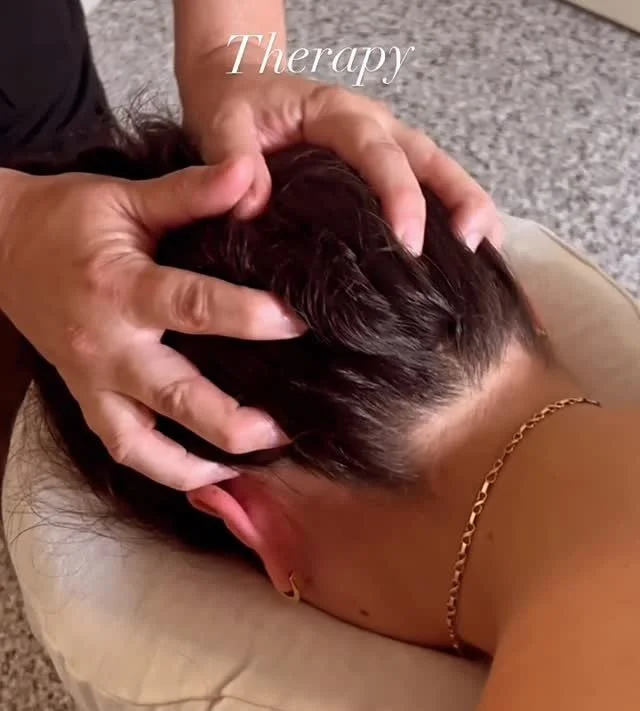
An RMT trained in headache treatment will spend real time on these structures. Not just a quick neck rub, but intentional, specific work. Finding the tight bands. Applying sustained pressure to trigger points. Moving through the tissue with enough depth to create change.
The difference between that and a generic back rub is significant.
What to Expect During a Session
Coming in for the first time with headaches? Here's how it usually goes.
Your therapist will ask questions before anything else. Where is the pain? How often? Does it start in the neck? Do you clench your jaw? The intake matters because headaches have different origins, and the treatment follows from that.
From there, expect focused work on:
The base of the skull and cervical spine
Upper trapezius and the top of the shoulders
Scalp and temporal muscles (the ones over your temples and sides of the head)
Jaw-adjacent muscles if TMJ tension is part of the picture
Pressure is calibrated to what your body can receive. Some of the most effective work happens at medium depth, not deep tissue pounding, but firm, sustained contact that lets the nervous system actually respond.
Sessions are 60 or 90 minutes. For headaches that have been building for a while, a 90-minute session gives enough time to work through the neck, shoulders, and head without rushing.
How Often Should You Go
One session can bring real relief. Consistent sessions bring lasting change.
For people dealing with frequent tension headaches, say a few times a week, starting with sessions every two to three weeks and then spacing out as things improve tends to work well. For migraines, the same approach applies, with a longer horizon.
The goal over time is to change the baseline. To get your body out of the pattern of constant bracing and give it a new normal. That doesn't happen in one visit, but it absolutely can happen.
A package of four sessions is often a good starting point. It gives enough continuity for your therapist to track what's shifting and for your body to actually integrate the work between visits.
A Few Things Worth Knowing
Headache relief without medication isn't always possible for every person or every headache type. Massage therapy is a powerful tool, and for many people it significantly reduces reliance on pain relievers. It works alongside other care, not in place of it when something more serious is involved.
Drink water after. This isn't just a wellness cliché. Metabolic waste released from worked tissue moves out more efficiently when you're hydrated. Skipping water after a session can make you feel heavier than you expected.
You might feel tired after. That's normal, especially if your nervous system has been running hot. Consider it your body finally exhaling.
RMT Headache Treatment in Griffintown
Centre Thérapeutique Griffintown is located in the heart of the neighbourhood, in a space designed to feel like a genuine exhale the moment you walk in. Natural light, minimalist design, rooms named after Griffintown streets. The kind of environment that already starts the work before your therapist even begins.
Every massage therapist on the team is a certified RMT, a member in good standing of professional massage therapy associations. The headache work they do is therapeutic, targeted, and adapted to what your body is actually presenting. No guesswork.
Sessions run 60, 90, or 120 minutes, and full payment is required at booking. Cancellations with 24 hours' notice receive a full refund.
When Your Head Finally Gets Some Rest
Headaches can become background noise. Something you just manage, work around, push through. But the body tends to escalate what gets ignored. What starts as occasional tension becomes a weekly thing, then more.
Massage therapy for headaches works because it doesn't just interrupt the pain. It addresses what's been building underneath it. The muscles that haven't let go. The nervous system that hasn't had a reason to.
Booking a session is a small act. The relief it can bring is anything but.
Book your session at centretherapeutiquegriffintown.com
Frequently Asked Questions
How many sessions do I need to see results for headaches?
Many clients notice a difference after one session, particularly with tension headaches. For lasting change, especially with frequent or chronic headaches, a series of sessions is more effective. Starting with four and reassessing from there is a common approach.
Do I need a referral to book a massage therapy session?
No referral needed. You can book directly through the website.
What's the difference between a 60 and 90-minute session for headaches?
A 60-minute session allows focused work on the head, neck, and upper back. A 90-minute session gives more time to also address the mid-back, jaw, and scalp more thoroughly, which is useful when tension is spread across multiple areas.
Can massage help with migraines specifically?
Yes, though it works differently than for tension headaches. Regular massage therapy can help reduce migraine frequency and intensity by calming the nervous system and reducing muscular triggers. It's a longer-term investment rather than an immediate fix.
What are the session rates?
60-minute session: $120 + tax. 90-minute session: $180 + tax. 120-minute session: $240 + tax. Package of 4 sessions (massage of your choice): $400 + tax.